






















Skip to content
QuorlyticTalk to a Data ExpertContact
Menu

Data Engineering · Analytics · AI

Engineer Data. Activate Intelligence.

Quorlytic engineers the data foundations — pipelines, cloud platforms, warehouses and lakehouses — that activate analytics, machine learning and production AI your teams can trust and act on.

Fragmented data sources converging into a single governed platform, then serving three data products.
A demand signal resolving into a forecast with its uncertainty band shown.
Many customer signals resolving to one identity.

Technology ecosystem

Technologies we work with. No partnership or certification is implied.

  • AWS
  • Azure
  • Google Cloud
  • Snowflake
  • Databricks
  • BigQuery
  • Power BI
  • Tableau
  • Python
  • Spark
  • dbt

Quorlytic intelligence engine

From raw business data to a decision.

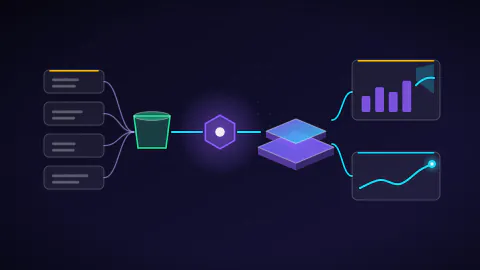
Sources flow through a governed pipeline into a data platform, branch into analytics, machine learning and enterprise AI, and end in the moment a team acts.

Core capabilities

From raw data to business decisions.

Seven connected disciplines. Start where you need clarity, then build the next capability when the business problem and the data support it.

Capability 01

Data Engineering

Business problem
Reporting depends on manual exports, and a failed job is discovered by a business user.
Technical capability
Batch and change-data-capture ingestion, warehouse and lakehouse models, versioned transformations and quality tests.
Business outcome
Reliable data available when teams need it — with traceability, freshness and an owner.
Explore Data Engineering

Data engineering

A data foundation you can build on.

Connect fragmented sources to dependable data products — with quality, traceability, freshness and operational ownership designed in from the start.

  • Data pipelinesBatch and change-data-capture ingestion, traceable from source to metric.
  • WarehousesGoverned models and semantic layers built for the questions being asked.
  • LakehousesStaged raw, validated and business layers with clear ownership.
  • ETL / ELTVersioned transformations, accuracy checks and safe backfills.
  • StreamingLower-latency paths introduced only where the decision requires them.
  • IntegrationsERP, CRM and API connections with documented dependencies.

Technology ecosystem

The stack, by discipline.

Platform choices follow the workload, existing skills and operating cost — not a default vendor.

01 / 07

Data Engineering stack

Pipelines, orchestration and transformation.

6 technologies

  • Python
  • SQL
  • Spark
  • Airflow
  • dbt
  • Kafka

Technologies we work with. No partnership or certification is implied.

See how platform decisions are made, and the trade-offs behind each one

Business outcomes

Data infrastructure built around business outcomes.

Every engagement starts from a decision. The architecture, the metrics and the operations all point at the result the business needs to improve.

01

Unified data

One reconciled view of customers, operations and finance, so decisions stop depending on whose spreadsheet is open.

02

Real-time intelligence

Freshness targets matched to the decision — batch where it is enough, streaming only where latency changes the outcome.

03

Predictive insight

Forecasts and models with documented limits, so teams act on probability rather than a single confident number.

04

Automated decisions

Approved workflows that route recommendations to people and systems, with an audit trail and a safe way to intervene.

See these as scoped solutions: Customer 360, demand forecasting, enterprise AI search

Analytics & BI

One definition. A clearer decision.

Reporting becomes dependable when a metric is defined once and the view is built around the meeting where the decision happens.

  • Executive analyticsA small set of trustworthy measures for leadership review.
  • Operational dashboardsViews built around a specific team's daily decision.
  • Customer intelligenceSegments and behaviour connected to a defined action.
  • Financial reportingReconciled figures with clear definitions and owners.
  • Automated reportingScheduled delivery that removes manual export work.
Illustrative governed business intelligence interface connecting a revenue definition to executive, operational and reporting views.
Illustrative decision interface — example values only; not client data or results.

AI & machine learning

Move from historical reporting to predictive intelligence.

Bounded models and assistants that support a decision — evaluated against a baseline, with visible uncertainty and a safe fallback.

  • ForecastingDemand and planning horizons with uncertainty shown.
  • Predictive modelsClassification and regression tied to a decision.
  • Recommendation systemsRanking and next-best-action with measured value.
  • Anomaly detectionSignals for unusual operations, quality or spend.
  • AI assistantsBounded help with approval and access controls.
  • RAGPermission-aware retrieval with citations and evaluation.
Illustrative predictive analytics interface showing historical demand, a forecast range, anomalies and recommended actions.
Illustrative decision interface — example values only; not client data or results.

Selected work

Evidence, published only when it is real.

Published only with the client's approval. Each study shows the starting situation, the architecture delivered and what it enabled, without invented figures.

Manufacturing · Case studyPublished

An AWS data platform for manufacturing demand intelligence

Quorlytic engineered an AWS data platform that unified a manufacturer's ERP, sales, production and inventory data through automated ETL, put Power BI reporting on one trusted layer, and added a Python demand forecast built on the same history.

Retail & Ecommerce · Customer dataIn preparation

Customer view with identity resolution

Structured to show source reconciliation, matching rules, permission handling and the workflow it supported.

Financial services · ReportingIn preparation

Governed reporting platform

Structured to show metric definitions, access controls, reconciliation and the operational handover.

All case studies

Delivery model

Always know what happens next.

Every engagement has an owner, a testable result and a way to operate it after handover.

01

Discover

Agree the decision, map the data and define acceptance criteria before building.

02

Design

Choose the architecture around workload, governance and operating cost.

03

Build

Deliver a focused data product with quality checks and access controls.

04

Deploy

Release with monitoring, runbooks, rollback and a named owner.

05

Optimize

Review incidents, cost and adoption, then improve deliberately.

Why Quorlytic

Engineering-first. Business-focused.

Method, technical specificity and transparent scope supply credibility — not logos we have not earned.

  • Engineering-first

    Source contracts, versioned code, tests and runbooks — artifacts you can review, not slideware.

  • Business-focused

    Every engagement starts from a decision and a measurable acceptance criterion.

  • Cloud-native

    Platform choices follow the workload, existing skills and operating cost — not a default vendor.

  • AI-ready

    Data access, permissions and freshness prepared before any model or assistant is deployed.

  • Scalable architecture

    Designed to start small, prove value, and extend without a rebuild.

Your next data decision

Build the data foundation for your next stage of growth.

Bring the business question. We will help shape the engineering brief and a testable first step.